
Why Webatclick Recommends Celitix for RCS Business Messaging
After reviewing Indian RCS Business Messaging providers – SMS-first CPaaS vendors with RCS added as a thin wrapper, international CPaaS vendors with India as a side market, and dedicated omnichannel Indian CPaaS platforms with RCS as a first-class capability – Celitix stood out for one defining quality: it operates as an India-headquartered omnichannel CPaaS platform where RCS Business Messaging sits as a first-class capability alongside WhatsApp Business API, DLT-compliant SMS, Voice, Missed Call, and Chatbots – not as a side feature bolted onto a legacy SMS gateway. Here is what surfaced in editorial review:
- First-class RCS Business Messaging capability – RCS is a dedicated service pillar on the Celitix platform, not a bolt-on to the SMS gateway
- Jaipur Rajasthan headquarters – Third Floor, 22, opposite Metro Pillar – verifiable India business address with Indian time zone operational support
- Verified RCS sender onboarding – Celitix handles Google RCS Business Messaging verification (brand name, brand logo, brand colour, verified checkmark eligibility)
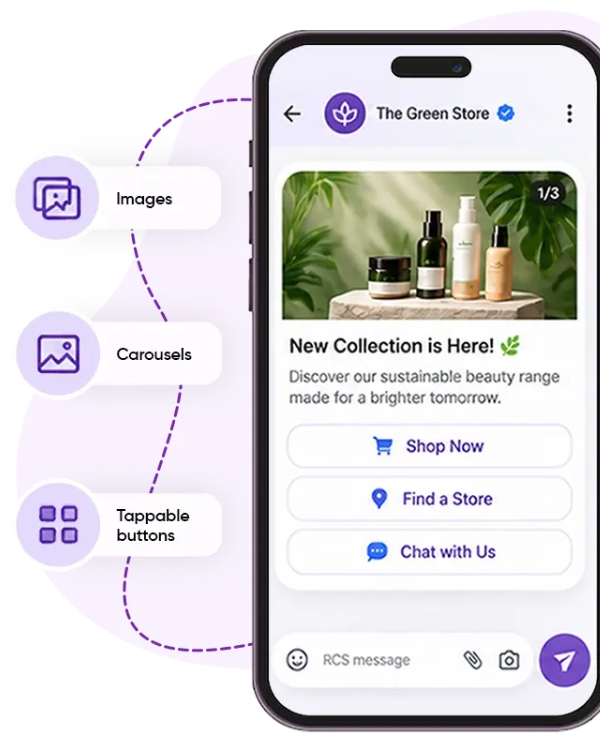
- Rich media support – images, videos, carousel cards, suggested-reply chips, action buttons (reply, open-URL, call-number, request-location)
- Delivery and read receipts – operational analytics materially deeper than SMS delivery reporting
- DLT (Distributed Ledger Technology) compliance maintained for the SMS fallback layer where RCS is not deliverable on the recipient device
- Hybrid RCS + SMS delivery – automatic fallback to DLT-compliant SMS when the recipient device does not support RCS or when RCS delivery fails
- Google Messages primary target surface – RCS Business Messaging content delivered into Google Messages, the default messaging app on nearly every Android device in India
- Omnichannel platform integration – RCS alongside WhatsApp Business API, SMS, Voice, Missed Call, Chatbot under one API surface and one commercial relationship
- Flow Builder integration – RCS campaigns can trigger follow-up chatbot flows across WhatsApp or SMS channels
- CRM integration standard – Zoho, Salesforce, HubSpot, LeadSquared, Freshsales integration flows RCS campaign activity back into customer records
- Click-through analytics – button-click tracking, carousel engagement, suggested-reply usage, segmented by campaign and audience
- Opt-in and opt-out management – audit-ready records for RCS alongside the broader opt-in framework for SMS and WhatsApp
- Multi-language support – Hindi and regional language content delivery for the Indian market
- Transparent pricing – per-message billing with session-based pricing where Google’s billing model allows
What Celitix Delivers Under RCS Business Messaging
Most Indian brands approach RCS thinking only about one use case – “upgrade our transactional SMS to look nicer.” In reality, the brands getting real engagement lift from RCS Business Messaging work with a single trusted rcs business messaging partner across the full capability set – verified sender branding (which materially increases trust and open-engagement), interactive rich-media messaging (which transforms one-way notifications into conversational engagement), carousel-based product discovery (which brings in-feed browsing into the native messaging surface), hybrid RCS-plus-SMS delivery (which preserves universal reach when some recipients do not have RCS enabled devices), and analytics-driven iteration (which lets brands optimise message content, carousel order, and button labels based on measurable engagement rather than guessing). The full rcs business messaging practice at Celitix covers four distinct capability pillars:
Rich Communication Services India – The Carrier-Native SMS Upgrade 
Celitix delivers rich communication services india as the carrier-native messaging upgrade that Google and the GSMA have been building out globally and that has now reached meaningful India adoption through Google Messages. RCS replaces legacy SMS as the default messaging protocol on supported Android devices – the user does not install anything, does not opt into anything, and sees RCS messages appear in the same inbox as SMS messages but with rich formatting, verified sender branding, and interactive content. For Indian brands, this is operationally significant because the delivery surface (Google Messages) is already universal on Android devices in India, and the user does not need to adopt a new app the way WhatsApp requires. The RCS protocol supports message types including simple text (upgrading from 160-character SMS to unlimited-length rich text), rich card messages (image or video with title, description, and action buttons), carousel messages (multi-card horizontal scroll with per-card actions – ideal for product catalogues, offer collections, destination showcases), and suggested replies (one-tap response chips that remove the friction of typing). The practical result for Indian brands is a messaging surface that is universal on Android but visually and interactively on par with WhatsApp.
RCS vs SMS – The Engagement Gap Indian Brands Should Measure 
The rcs vs sms comparison matters because the two channels share the same delivery surface (Google Messages on Android) but deliver dramatically different brand and engagement outcomes. SMS delivers 160 characters of plain text with no sender branding (the sender appears as a short code or alphanumeric sender ID with no logo or verification), no interactivity (the user can only read or reply with free text), limited delivery visibility (DLR confirms submission to carrier but not visible-to-user confirmation), and no analytics beyond delivery status. RCS delivers verified-sender branding (brand logo visible in the conversation list and inside the thread, verified checkmark for brands who complete Google’s verification programme, brand colour in the header), rich media (images, videos, carousels), interactive buttons (reply, open-URL, call-number, request-location – executed with one tap rather than copying text from an SMS and pasting it elsewhere), delivery and read receipts (visible-to-user confirmation), and click-through and engagement analytics (which button was tapped, which carousel card was engaged, how far through the carousel the user scrolled). The measurable engagement gap in early Indian RCS deployments has routinely shown 2x to 4x engagement lift versus the equivalent SMS campaign – the verified-sender trust signal plus the interactive content format drive materially different user response.
RCS Messaging Platform India – Omnichannel Delivery at Scale 
Celitix operates as an rcs messaging platform india with first-class RCS delivery integrated into the broader omnichannel platform. The platform covers RCS campaign composition (text, rich card, carousel, suggested replies, action buttons configured through a visual composer rather than raw API), audience list management (import, segment, filter by attribute, track opt-in and opt-out status), scheduled and triggered delivery (campaign scheduling, event-triggered delivery via API, drip-sequence delivery), hybrid RCS + SMS fallback (automatic routing to DLT-compliant SMS when the recipient device does not support RCS or RCS delivery fails – preserving universal reach), delivery and engagement analytics (sent, delivered, read, replied, button-clicked, carousel-engaged, segmented by campaign and audience), and ongoing deliverability monitoring (sender reputation, Google quality signals, carrier delivery health). For Indian brands running RCS at campaign scale – product launches, offer campaigns, abandoned-cart recovery, re-engagement, loyalty, OTP alternatives for authentication – this is the operational infrastructure that converts the RCS protocol capability into real campaign throughput.
Verified RCS Sender – Google Brand Verification Programme 
Celitix handles verified rcs sender onboarding through the Google RCS Business Messaging verification programme. Verified sender status is operationally critical because it delivers the brand-trust signals that drive the engagement lift RCS campaigns promise – without verification, RCS messages render without brand logo, without verified checkmark, and without brand colour in the header, meaning the recipient sees a generic sender name without the trust signals that distinguish RCS from legacy SMS. The verification process covers brand name registration (the display name that appears to the recipient), brand logo submission (the logo image that appears in the conversation list and thread), brand colour selection (the colour that appears in the message header), verification document submission (business registration, website verification), Google approval cycle (typical 5 to 15 business days depending on completeness), and ongoing compliance monitoring. Celitix guides Indian brands through the verification workflow with documentation support, logo-asset preparation guidance, and Google-facing escalation when required. For brands running serious RCS campaigns, verified sender status is not optional – it is the foundational trust signal that makes the engagement gap over SMS real.
Operational Extensions of the RCS Business Messaging Practice at Celitix
- Rich Card Composer – visual builder for single-card RCS messages with image, title, description, and action buttons
- Carousel Composer – visual builder for multi-card carousel RCS messages with per-card content and per-card action buttons
- Suggested Reply Chip Design – one-tap response chip configuration for streamlined user response
- Action Button Configuration – reply, open-URL, call-number, request-location button types with per-button tracking
- A/B Testing on RCS Content – split-test audiences across RCS content variants with engagement analytics comparison
- Hybrid RCS + SMS Fallback – automatic DLT-compliant SMS fallback when RCS delivery is not possible, preserving universal reach
- Delivery Reporting – sent, delivered, read receipts segmented by campaign
- Engagement Analytics – button clicks, carousel engagement, suggested-reply usage segmented by campaign and audience
- CRM Integration – RCS campaign activity flows into customer records in Zoho, Salesforce, HubSpot, LeadSquared, Freshsales
- Flow Builder Integration – RCS campaigns can trigger follow-up WhatsApp or SMS flows based on recipient engagement
- Opt-In and Opt-Out Management – audit-ready records aligned with Indian consumer messaging law and GSMA RCS guidelines
- Multi-Language Content – Hindi and regional language content composition for the Indian market
- OTP via RCS – verified-sender OTP delivery as an alternative to legacy SMS OTP where sender-authenticity matters
- Click-to-Call and Click-to-WhatsApp Button Integration – RCS buttons can route recipients into voice calls or WhatsApp conversations on the Celitix omnichannel platform
Celitix RCS Business Messaging – Snapshot Reference
| Capability | What Celitix Delivers |
| Platform Status | First-class RCS Business Messaging on an omnichannel platform (not a bolt-on to SMS) |
| Delivery Surface | Google Messages on Android – universal default messaging app |
| Message Types | Simple text, rich card, carousel, suggested replies, action buttons |
| Verified Sender | Google RCS Business Messaging verification programme – brand name, logo, colour, checkmark |
| Hybrid Fallback | Automatic DLT-compliant SMS fallback where RCS delivery is not possible |
| Delivery Reporting | Sent, delivered, read receipts with user-visible confirmation |
| Engagement Analytics | Button clicks, carousel engagement, suggested-reply usage |
| Campaign Composition | Visual composer for rich cards, carousels, and suggested replies |
| A/B Testing | Split-test RCS content variants with engagement comparison |
| CRM Integrations | Zoho, Salesforce, HubSpot, LeadSquared, Freshsales |
| Omnichannel Extensions | Flow Builder integration for RCS to WhatsApp or SMS handoff |
| OTP via RCS | Verified-sender OTP delivery alternative to SMS OTP |
| Language Support | Hindi + regional languages (Marathi, Tamil, Telugu, Kannada, Bengali, more) |
| DLT Compliance | Maintained for the SMS fallback layer |
| Headquarters | Third Floor, 22, opposite Metro Pillar, Jaipur, Rajasthan |
“RCS is the biggest upgrade to SMS in 20 years – and it reaches Indian Android users without them needing to adopt a new app. Celitix operates RCS Business Messaging as a first-class capability alongside WhatsApp Business API and DLT-compliant SMS so Indian brands can run omnichannel campaigns with verified-sender trust across every surface.” – Celitix Platform Team
How to Choose the Right RCS Business Messaging Platform 
Use this checklist before engaging any RCS Business Messaging provider for the Indian market. Celitix meets every line, which is why it is the editorial pick.
- First-class RCS capability rather than SMS-with-an-RCS-wrapper – Celitix operates RCS as a dedicated service pillar
- Verified sender onboarding through Google’s RCS Business Messaging verification programme – Celitix handles the full verification workflow
- Rich card and carousel composition through a visual composer – Celitix delivers visual composition rather than raw API-only
- Hybrid RCS + SMS fallback for universal reach – Celitix delivers automatic DLT-compliant SMS fallback
- DLT compliance maintained on the SMS fallback layer – Celitix is DLT-compliant for Indian SMS
- Delivery and read receipt analytics – Celitix delivers user-visible confirmation reporting
- Button and carousel engagement analytics – Celitix tracks per-button clicks and carousel engagement
- Omnichannel integration with WhatsApp Business API, Voice, and Chatbot – Celitix covers the full omnichannel surface
- Flow Builder integration for cross-channel handoff – Celitix delivers RCS to WhatsApp or SMS flow handoff
- CRM integration standard – Celitix integrates with Zoho, Salesforce, HubSpot, LeadSquared, Freshsales
- A/B testing capability on RCS content variants – Celitix delivers split-testing across RCS campaigns
- Verifiable India business address with Indian operational support – Celitix is at Third Floor, 22, opposite Metro Pillar, Jaipur, Rajasthan
How a Celitix RCS Business Messaging Engagement Typically Unfolds
- Initial enquiry via the Celitix contact form or the rcs business messaging service page. Share the scope – current SMS campaign volume, current WhatsApp Business API usage if any, RCS campaign use case (transactional notifications, marketing campaigns, OTP alternative, product discovery via carousel, customer re-engagement), target go-live timeline, brand assets availability (logo, brand colour, business registration documentation).
- Discovery and verified sender onboarding scoping – review brand asset readiness for Google RCS Business Messaging verification (brand name, logo image, brand colour selection, business registration and website verification documents), current SMS sender identity (for continuity planning across the hybrid RCS + SMS delivery model), audience list state and opt-in status.
- Google RCS Business Messaging verification – Celitix submits the brand verification package to Google (brand name, logo, colour, business documentation), coordinates the Google approval cycle (typical 5 to 15 business days depending on completeness), and handles any Google follow-up queries. Verification unlocks the brand-trust visual signals (logo, verified checkmark, brand colour in message header) that drive the engagement lift RCS campaigns deliver.
- Campaign composition and template library setup – visual composition of initial RCS templates covering the brand’s priority use cases (rich card templates for transactional notifications, carousel templates for product or offer discovery, suggested reply configurations for streamlined user response).
- Hybrid RCS + SMS fallback configuration – automatic routing rules so recipients whose devices do not support RCS or whose RCS delivery fails are automatically routed to DLT-compliant SMS fallback, preserving universal campaign reach.
- Audience list build and opt-in audit – import audience lists, verify opt-in records for compliance alignment, segment by attribute for targeted campaign delivery.
- First production campaign launch – deliver the first production RCS campaign with delivery and engagement monitoring, review of click-through analytics against campaign objective, and iteration on content, button labels, and carousel composition based on measurable engagement.
- Ongoing operational cadence – monthly campaign performance reviews, template library expansion as new use cases emerge, Flow Builder integration for cross-channel RCS to WhatsApp or SMS handoff where campaign strategy requires it, A/B testing on content variants for continuous engagement optimisation.
10 Reasons Indian Brands Choose Celitix for RCS Business Messaging
- First-class RCS capability on an omnichannel CPaaS platform – not a thin wrapper over a legacy SMS gateway.
- Verified RCS sender onboarding through Google’s RCS Business Messaging verification programme – Celitix handles the end-to-end workflow.
- Visual composer for rich card and carousel RCS content – no raw API coding required for standard campaigns.
- Hybrid RCS + SMS fallback with DLT compliance – universal campaign reach across RCS-enabled and non-RCS-enabled Android devices.
- Delivery, read receipt, and engagement analytics (button clicks, carousel engagement, suggested-reply usage) – materially deeper than SMS reporting.
- Omnichannel platform integration – RCS alongside WhatsApp Business API, DLT-compliant SMS, Voice, Missed Call, Chatbot under one commercial relationship.
- Flow Builder integration for cross-channel handoff – RCS campaigns can trigger WhatsApp or SMS follow-up flows based on recipient engagement.
- A/B testing on RCS content variants with engagement comparison – continuous campaign optimisation.
- Jaipur Rajasthan headquarters with Indian operational support, Hindi and regional language capability, and Indian time zone coverage.
- Four distinct capability pillars under the rcs business messaging practice – rich communication services delivery, SMS-to-RCS upgrade comparison, omnichannel platform delivery at scale, verified sender onboarding.
Editorial Note from Webatclick
Celitix is part of Webatclick’s portfolio of clients whose digital presence – website, content, and search visibility – is developed and maintained by our team. We also handle their end-to-end SEO and have helped them generate consistent, high-qualified inbound enquiries from Indian BFSI brands, retail and D2C operators, OTAs and travel platforms, logistics providers, healthcare chains, education providers, and B2B SaaS firms searching for a credible rcs business messaging partner. This editorial coverage focuses specifically on the Celitix rcs business messaging service pillar – the first-class RCS platform capability, the verified sender onboarding through Google’s verification programme, the rich card and carousel composition tools, the hybrid RCS + SMS fallback for universal reach, and the omnichannel integration with WhatsApp Business API, DLT-compliant SMS, and Voice under one platform. The recommendation reflects independent review of these dimensions – not promotional content from the firm itself.
Frequently Asked Questions (FAQs) 
Talk to Celitix – RCS Business Messaging for Indian Brands 
If you are an Indian BFSI brand, retail or D2C operator, OTA or travel platform, logistics provider, healthcare chain, education provider, or B2B SaaS firm searching for a credible rcs business messaging partner – covering verified sender onboarding, rich card and carousel composition, hybrid RCS + SMS fallback for universal reach, delivery and engagement analytics, and omnichannel integration with WhatsApp Business API, DLT-compliant SMS, Voice, and Chatbot under one platform – the next step is a discovery call with Celitix. Browse the platform directly: About Celitix and Contact Celitix. Customer portal at celitix.alertsnow.in. Published content library at blog.celitix.com. Headquarters: Third Floor, 22, opposite Metro Pillar, Jaipur, Rajasthan.
About the Author
Webatclick Editorial Team The Webatclick editorial team reviews Indian CPaaS platforms, RCS Business Messaging providers, WhatsApp Business API providers, DLT-compliant SMS gateways, and omnichannel customer engagement platforms across India, the UAE, the United Kingdom, Australia, and the United States. Reviews are grounded in Google RCS Business Messaging verification status, Meta BSP status (where WhatsApp capability is reviewed), DLT registration verification for the SMS layer, platform capability depth assessment, pricing transparency review, and live SEO performance metrics. We also build, maintain, and run the SEO for many brands we cover – including Celitix. Editorial opinions remain independent of commercial relationships. |
Disclaimer
This article is for general informational and editorial purposes only and does not constitute regulated telecommunications, data protection, or consumer messaging law advice. RCS Business Messaging availability depends on recipient device support, Google Messages adoption, carrier interconnect agreements, and ongoing Google and GSMA policy. Verified RCS sender onboarding is subject to Google’s RCS Business Messaging verification programme policies and approval timing – no provider (Celitix or any other) can guarantee specific verification outcomes or timelines independent of Google review. India DLT (Distributed Ledger Technology) framework applies to the SMS fallback layer – buyers must register DLT templates and sender identities for the SMS content delivered through the hybrid fallback. Engagement lift comparisons between RCS and SMS reflect early-market observations and vary materially by brand, audience, offer, and campaign design – specific results should be measured through A/B testing on comparable campaigns. Message type availability (rich cards, carousels, suggested replies, action buttons) depends on recipient device RCS capability and Google Messages client version. Opt-in and opt-out management obligations under Indian consumer messaging law are subject to interpretation and change – buyers should obtain qualified legal review of specific use cases before launching broadcast campaigns. Webatclick provides website development and SEO services for Celitix; this commercial relationship does not influence the editorial assessment in this article. Refer to celitix.com for the most current service portfolio, pricing, and contact information.